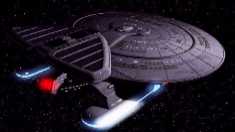
NCC-5852-A, U.S.S. MANTICORE
Nebula Class Vessel Information

 Overview
The Nebula Class of Starship, a direct offshoot from the Galaxy Class project, was started in 2357.
The fleet, after viewing the potential that the Galaxy class project was offering, decided to build a
further class of ship based on the Galaxy. Intended as a cheaper, less cost-intensive platform than
the Galaxy, the Nebula was designed to supplement the Galaxy's limited numbers in the upgrade of
the venerable Ambassador Class and New Orleans Class ships. Many parts of the Nebula are
ripped directly from the Galaxy class: the saucer, the warp nacelles, and the warp core, along with
a few of the computer systems. The plan was for a universal drive section that could function as
emergency transportation. The Galaxy Class drive section was overly large and, although very
efficient at what it did, was difficult to rebuild. There was a need to transport a non warp-capable
saucer section and it was decided to build a small drive section using existing Galaxy class components
that could attach to a standard saucer section. However, there are many more differences. For instance,
the saucer section cannot seperate on the Nebula class. Many systems which are hard-locked into the
Galaxy's design are included in the Nebula only as plug-in components.
As the project continued and the first prototype was built there was a need for a saucer section to test
with the ship. The saucer section from the pathfinder vessel, the USS Galaxy, was borrowed. Following
a successful test flight, the fleet decided to forgo the universal saucer transport idea. A saucer section
was specifically built for the project, now officially named Nebula. The new saucer section had smaller
decks than the Galaxy which allowed for greater maneuverability. Further upgrades and redesigns were
done on the vessel and further space frames were built. Eventually the first ship, USS Nebula was
deemed deep space worthy in 2371.
The large modules above the stern contain different systems and are installed modularly dependent on the
Nebula's current mission. There are several different modules, each installed for a specific mission profile,
for instance, for an exploration mission, a sensor suite would be installed; for an evac mission, extra living
quarters would be installed; for a combat mission, a weapons array would be installed, etc. While this feature
makes the Nebula class more mission-specific, it also allows for greater adaptability. Future modifications
can be made with very little structural reworking or cost.
Overall, the Nebula class of ships are very able and friendly ships suitable for a host of missions, although
the very mission they were designed for has never been put to operation as yet. An inside joke at Utopia
Planitia is the inscription just below the registry number for the USS Nebula. Look closely and you will find
the words:
"Designed in a Bar, Built in a Shed, Piloted by Madmen."
For more details, there is a detailed engineering manual compiled by Chief Engineer Garnoopy
Chronology
2357: Design Brief for the universal towing ship submitted and approved.
2361: Production of prototype drive section begins.
2364: Parts are pilfered from every source (mainly the Galaxy Class project) as designers rush to complete
delayed drive section.
2365: Fleet HQ orders that proper requisition forms be filled in and sent to quartermaster after production
on Galaxy class USS Trident is delayed due to lost parts. In the following week fleet HQ quartermaster
receives 1782 requisition orders. Production on the drive section continues.
2367: In the last month of the year the prototype drive section is completed. After an aborted attempt to
hijack USS Galaxy's saucer section, official request arrives at Fleet HQ asking to borrow the Galaxy's
saucer section. Order is approved.
2368: Shakedown test crew arrive back and send a gleaming report to Fleet HQ. USS Galaxy sends a
request for saucer section to be returned. Fleet inspectors view the drive section for viability as a new class
of ship. Inspectors are impressed and give the go-ahead for specific saucer section to be designed.
2369: Project is given official designation as the Nebula Class project.
2371: New saucer section is completed and attached to the prototype vessel, now named USS Nebula.
2372: USS Nebula is launched after modifications to the drive section (deep space worthy parts, weapons
systems, and a new navigational array.
Standard Nebula Crew Manifest and General Statistics
Officer Crew: 120
Enlisted Crew: 340
Civilians (Families): 120
Maximum Capacity: 1900
Standard Number of Decks: 33
Height: 75 Meters
Width: 467 Meters
Length: 421.5 Meters
Warp Engines: Standard M/ARA
Impulse Engines: Standard
Computer System: LCARS
Expected Life: 100 Years
Time between Refits: 5 Years
Category: Freighter/Explorer
Commissioned Vessels
USS Shiloh NCC-11172 Current Status - Active
USS Bellerphon NCC-6085 Current Status - Destroyed at Wolf 359
USS Endeavor NCC-7185 Current Status - Active
USS Hera NCC-10376 Current Status - Lost, presumably destroyed
USS Leeds NCC-2821 Current Status - Active
USS Manticore NCC-5852-A Current Status - Active
USS Lexington NCC-11199D Current Status - Active
USS Merrimac NCC-6187 Current Status - Active
USS Monitor NCC-6826 Current Status - Destroyed (Defiant Class vessel gained this name)
USS Nebula NCC-0122D Current Status - Destroyed at Wolf 359
USS Sutherland NCC-5771 Current Status - Lost, presumed Destroyed
USS Prometheus NCC-7121C Current Status - Active
USS Tolkien NCC-7215 Current Status - Active
USS Farragut NCC-5869 Current Status - Undergoing Repairs
Production currently halted to make way for the Sovereign Class project.
 Detailed information on the Manticore
 The Current Roster: Who's Who on the Crew
 Look at some images of the ship
Do you have any questions about Star Trek Simulation Forum (STSF)?
 What if I wanna go to the Quartermaster's Office?
Return to the Manticore's Home Page